UWILD Survey: A Complete Guide to Underwater Inspection in Lieu of Dry Docking
Dry docking is costly and time consuming. Historically, a vessel or offshore asset to remain in-class was physically out of the water, and was required to undergo a hull inspection every five years. It cost weeks of lost revenue and a logistical nightmare in getting a slot in a busy shipyard, and huge mobilization costs.
A smarter alternative is an Underwater Inspection in Lieu of Dry Docking (UWILD) survey, which is a more cost-effective method. With improved imaging and underwater technology, the owners are able to meet the requirements of the classification society when the vessel is still afloat. This guide will discuss how UWILD inspection services work and why they have become the standard of operational performance in the industry.
What is a UWILD Survey?
A UWILD survey is a specialized underwater hull inspection procedure, in which the underwater parts of the vessel are inspected when the ship is at quay or at anchor. The phrase in lieu of dry docking means that this inspection is a substitute to the required out-of-water survey by maritime law.
An offshore UWILD survey, approved by major classification societies (ABS, DNV, or Lloyds Register), targets the integrity of the hull structure, the state of the sea chests, rudders, propellers, and anti-corrosive systems. It is the compromise between safety compliance and optimum vessel availability.
Why UWILD Survey is Important for Marine Operations
When it comes to maritime logistics and offshore energy, time is of the essence. The UWILD survey is essential as it deals with three pillars:
- Minimize Downtime: A UWILD can take 24 to 48 hours instead of weeks to complete in a shipyard.
- Sustaining Vessel Availability: Have your FPSO or bulk carrier on station, and keep making money whilst the audit is conducted.
- Ensure Safety: Routine hull integrity checks make sure that small problems, such as broken welds or dirty sea chests, do not turn into sea emergency problems.
With the focus on marine vessel inspection using UWILD, operators will be able to align their safety inspections with their current port visits or offshore work.
How UWILD Survey Works
The essence of a UWILD is to give the visual representation of what the ship would look like in a dry dock to the person who will be conducting the survey of the class.
- Preparation: The hull is frequently stripped of marine growth to make it viewable.
- Video Feed: HD cameras give the surveyor a real-time video feed of the surface.
- Reporting: This is recorded and photographed on every weld, valve, and plate as part of the final vessel certification inspection report.
Diver-Based Inspection
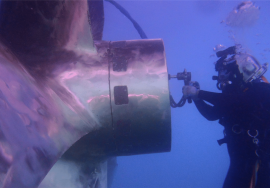
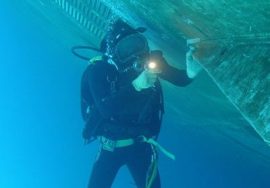
Conventional diver inspection services entail commercial divers who are highly trained and navigate through the hull. They have the added benefit of being able to provide the tactile feedback, enabling them to do minor repairs or manual underwater NDT inspection on site.
ROV (Remotely Operated Vehicle)
Underwater inspection by ROV is the best option in deep or high-current water. The current ROVs now have 4K cameras and laser scanning systems, which offer a safer and sometimes more accurate experience of subsea inspection services without endangering human lives.
Applications of UWILD Survey
Although theoretically any ship can experience a UWILD, it occurs most frequently in such high-value sectors:
- Ships and Vessels: Container ships and tankers which require maintenance of strict schedules.
- Offshore Platforms: Jack-ups and semi-submersibles, in which it is physically impossible to move to a dry dock.
- FPSOs: Floating Production Storage and Offloading units that are tethered to the seabed for years at a time.
- Subsea Structures: The stability of templates and manifolds as a result of offshore structure inspection.
Benefits of UWILD Survey
The ROI of offshore asset integrity through UWILD cannot be denied:
- Cost Savings: You avoid the “dockage fees,” tugboat costs, and the high price of shipyard labor.
- Operational Efficiency: Maintenance may be carried out during the cargo activities.
- Environmental Safety: This prevents oil leakage and safeguards the marine ecosystem since hull problems are detected early.
UWILD Survey vs. Traditional Dry Docking
Which of these two approaches should be used is something that is frequently subject to strategic planning in 2026.
Comparison of UWILD vs. Dry Docking.
The benefit of a UWILD survey over conventional dry docking is significant when comparing the two in terms of their effect on the bottom line of a fleet. Operational impact-wise, a UWILD enables a vessel to stay in the water and usually in operation, whereas dry docking entails a complete shutdown. The cost factor is also important; a UWILD will do away with shipyard mobilization and docking fees, which can be in the hundreds of thousands of dollars. Moreover, time spent on a subsea inspection takes days, whereas the time spent in a dry dock takes weeks. It is necessary to mention, though, that although UWILD is great to test hull integrity, it cannot accept large scale structural repairs or even a complete sandblasting, which also requires a dry dock setting.
Compliance and Certification Requirements
The only way a UWILD can be valid is by complying with the stringent criteria of classification society inspection.
- Accreditation: The UWILD service provider needs to be pre-certified by the particular society (e.g., ABS or Bureau Veritas) that certifies the vessel.
- Surveyor Presence: A class surveyor is required to be on the surface, looking at the live feed and telling the diver or ROV where to go to particular points of interest.
- Documentation: The report should be finalized with good quality imagery and NDT data to confirm that the vessel can serve the remaining 2.5 to 5 years.
Choosing the Right UWILD Service Provider
Not all marine inspection firms are prepared to meet the challenges of a UWILD. Look for: When choosing a partner, look for:
- Experience in the Industry: A track record in the offshore oil and gas inspection.
- Certified Equipment: High-spec ROVs and certified NDT equipment.
- Global Reach: The capability to send a dive team to your ship, at your exact position, be it in the port or at an offshore anchorage.
Contact qualified personnel to do an underwater inspection.
Cost of UWILD Survey Services
The UWILD survey price is much less than that of a dry dock, but it depends on:
- Vessel Size: A VLCC tanker will take longer bottom-time than a small supply boat.
- Inspection Scope: Do you need regular appearances or a multi-faceted underwater NDT inspection, such as thickness gauging or MPI (Magnetic Particle Inspection)?
- Visibility: The location of the water can impact the time taken to obtain a clear image.
Hint: It is always advisable to do a pre-cleaning on the hull. This accelerates the inspection process and minimizes the rate of the dive team or ROV per hour.
Conclusion: Efficient Inspection Without Downtime
The UWILD survey forms the strongest weapon in the arsenal of a shipowner to find the balance of profitability and safety. You would also make sure your fleet is operational and in compliance with minimal interruption by eliminating the reliance on dry docks to perform regular audits. The most efficient thing in the modern maritime economy is the capability of viewing under the water without being in the water.
Make sure that vessels are safe with professional UWILD survey services today.
Frequently Asked Questions (FAQ)
Q1. What is the average time of a UWILD survey?
Ans: A standard commercial vessel would take 24-48 hours to complete a UWILD survey based on the number of sea chests and the complexity of the propulsion system.
Q2. Would I be able to do a UWILD each time an inspection is necessary?
Ans: The classification societies permit, on average, two In-Water surveys to one Dry Dock survey, according to the age and condition of the vessel. Never forget about your particular class rules.
Q3. How will the surveyor react to the identification of a defect when the UWILD is conducted?
Ans: In case a major crack or structural breakdown is identified, the surveyor might need a “Condition of Class” (CoC), which can involve a dry dock for repair. Nevertheless, the underwater inspection services can be used to carry out many minor repairs by the dive team.
Q4.Is UWILD better with ROV or a diver?
Ans: It is dependent on the place. ROV underwater inspection is safer in a hazardous environment or in extremely deep water. Diver inspection services are usually better in locations that require manual scraping or tactile inspection.