The jetty is the rope between the sea and the land in the high-stakes world of sea logistics. These constructions have to withstand a 24/7 attack of saltwater, tidal forces, and biogrowth. In the absence of such a rigorous program of marine jetty piles inspection cleaning, the silent menace of pile wasting can result in catastrophic structural failure, which will stop the operations and cost millions of dollars in emergency repairs.
To ensure the structural integrity of these assets, operators need to have an active approach to ensure that these assets are protected, via their proactive strategy, which is known as the Detect and Protect strategy. Port authorities can make sure that their infrastructure is fit for purpose over decades by removing marine growth and using high-precision diagnostic tools.
What is Jetty Pile Inspection?
Jetty pile inspection is the systematic evaluation of the submerged and “splash zone” sections of a pile. Since the most violent types of corrosion take place where the water and air meet, a superficial examination of the surface is never sufficient.
A jetty underwater inspection aims at determining:
- Corrosion and Pitting: Steel is losing its thickness on the walls.
- Spalling: Fissures and fractures in concrete piles because of internal rusting of rebar.
- Biological Decay: Boring organisms that are able to hollow out timber piles on the inside.
- Mechanical Damage: Impact scars of ships or floating debris.
Importance of Jetty Pile Cleaning
Thou can not look into what thou can not see. In tropical and temperate waters, piles are soon overgrown by a thick layer of so-called biofouling of algae, barnacles, oysters, and tube worms.
Marine growth removal piles have two main uses:
- Supporting Accurate Inspection: Detectors and ultrasonic probes need to be physically in touch with the pile surface to be able to provide accurate information.
- Corrosion Mitigation: Some marine organisms produce acidic byproducts, which enhance the rate of corrosion of protective layers and the underlying metal. With the help of professional marine pile cleaning services, you open the way to a high-fidelity structural audit.
Common Methods for Jetty Pile Inspection
The current-day maintenance employs a Multi-Tier model of data collection to find the most precise data:
1. Diver Inspection
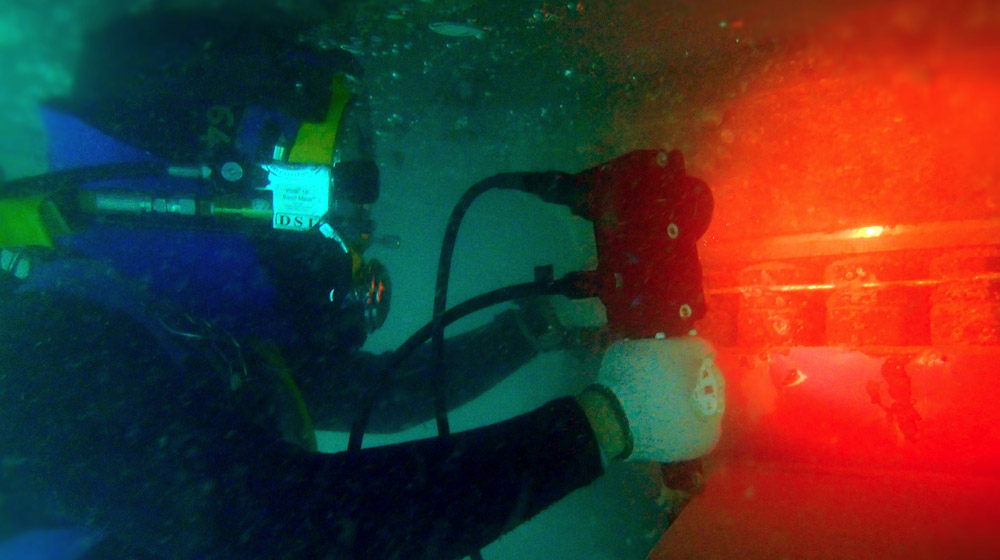
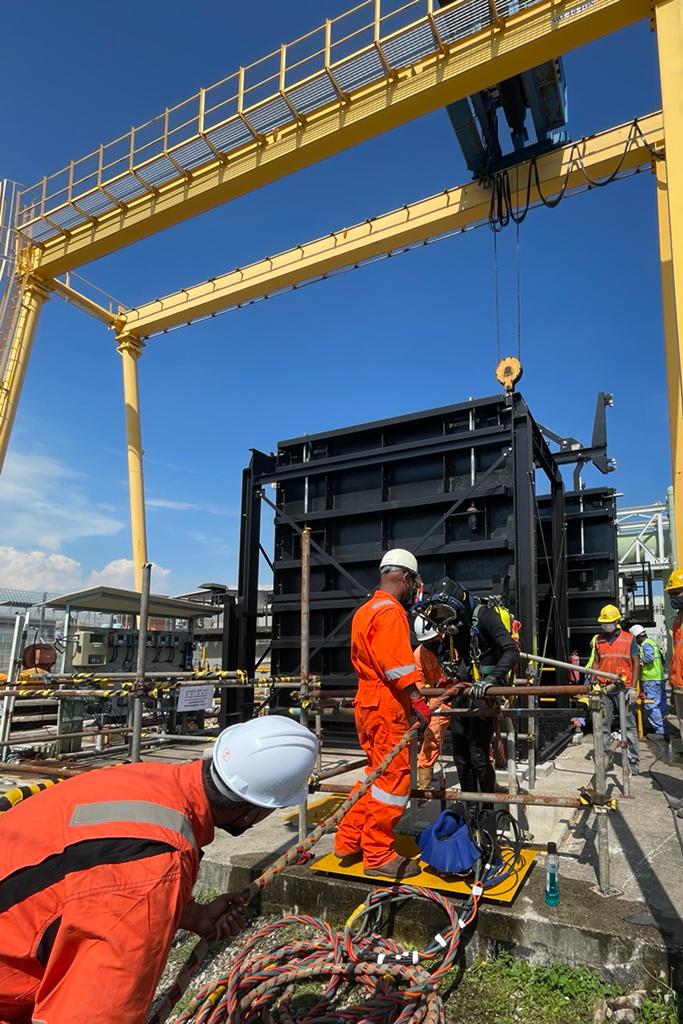
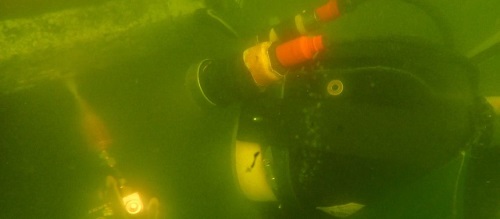
The gold standard in the complicated jetty constructions is certified commercial divers. A diver pile inspection can provide a “tactile” feedback type, where the diver can feel the cracks or soft points that the camera will fail to detect. Divers will also be required to conduct “Close Visual Inspections” (CVI) once the cleaning process is finished.
2. ROV Inspection
In deep water terminals or hazardous currents, ROV inspection jetty protocols are the preferred protocols. With 4K cameras and sonar, Remotely Operated Vehicles can map thousands of piles in a fraction of the time it would take a human diver, and all without putting the personnel in the pier at risk.
3. Ultrasonic Testing (UT)
The most common method of determining the remaining wall thickness of steel piles is ultrasonic testing of piles. Technicians can use this method to tell whether a pile has lost 10% or 50% of structural mass and reinforce it before the structural material fails.
Cleaning Techniques Used for Jetty Piles
The aim is to eliminate the growth without affecting the substrate underneath or the protective layers.
- High-Pressure Water Jet Cleaning: This process uses special nozzles that blast away the barnacles and oysters using seawater at a pressure up to 10,000 PSI.
- Mechanical Brushing: Hydraulic-driven rotating brushes, which are used to scrub the pile clean. This has been found to be quicker in the case of large-scale underwater pressure cleaning campuses.
- Vacuum Recovery Systems: In sensitive harbors, which are also sensitive to the environment, cleaning heads are equipped with suction hoses to trap the removed biological matter lest it cloud the water or lie at the bottom of the sea.
Applications of Jetty Pile Inspection Cleaning
This service is essential to any organization with management of coastal or offshore resources:
- Ports and Harbors: Making sure that the berths which giant container ships use are in good structural condition.
- Offshore Terminals: The piles of oil and gas loading facilities could be disastrous in a single leak.
- Coastal Infrastructure: Repairing of public piers, bridge supports, and promenade walkways.
- Marine Loading Facilities: Port jetty inspection services are important in the liquid bulk terminal where heavy piping is provided by the jetty structure.
Role in Structural Integrity and Safety
The most susceptible area of any jetty is the so-called Splash Zone. This is a continuously wet and dry area, which offers the ideal oxygen-saturated habitat for corrosion inspection piles. By cleaning and inspecting regularly, it is ensured that:
- Structural integrity Jetty: The load-bearing capability of the piles is checked with the original engineering specs.
- Early Warning: Since it is possible to identify where the necking is occurring (where a pile becomes thinner in one particular spot), it is possible to install the “Pile Jackets” or sacrificial anodes before the pile snaps.
Benefits of Marine Jetty Piles Inspection Cleaning
An investment in the pile protection services offers an enormous ROI:
- Extended Lifespan: A jetty that is well maintained can last 50+ years, whilst a neglected one may need replacing in 15 years.
- Safety and Compliance: Compliance with the demands of the international classification societies and local port authorities.
- Less Repair Costs: Spot-welding a tiny patch is much cheaper than replacing a 30-meter structural pile.
- Operational Uptime: Preventing the so-called unplanned closures that disrupt the global supply chains.
Challenges in Underwater Jetty Maintenance
Maintaining structural health subsea is never easy. Marine inspection challenges include:
- Low Visibility: Silt and sediment in harbors can often be impossible to visually perceive, unless with special-purpose lenses called clear water lenses, or sonar.
- High Tidal Currents: Divers can only work within the time periods of slack tide, and it would mean their project management would have to be precise.
- Accessibility: Large ROVs or dive boats may find it challenging to reach the “inner” piles of a wide jetty.
How to Choose the Right Service Provider
Not everything that is offered as marine engineering services is created equal. In choosing an underwater inspection contractor, consider:
- Certified Personnel: Do the divers have IMCA/ADAS certification? Do the NDT technicians have PCN or ASNT Level II?
- High-tech: Are they offering digital 3D Pile Mapping or simple photos only?
- Reporting Quality: The best report must have a “Traffic Light” system (Red/Amber/Green) to assist you in prioritizing which piles need to be attended to.
Select a reputable undersea inspection firm to provide reliable services for jetty piles.
Cost of Jetty Pile Inspection and Cleaning
The inspection cost of the jetty depends on the sum of the total “Wetted Surface Area” and the total “Fouling Rating.”
Expert Advice: The proactive inspection campaign typically costs less than 1% of the cost of a complete jetty rebuild. In the maritime industry, “Prevention is the only profit.”
Future Trends in Marine Infrastructure Maintenance
The industry is shifting towards Smart Jetties:
- Advanced Marine Inspection Technology: Permanent sensors on piles that transmit real-time thickness data to a cloud dashboard.
- Automated Cleaning Robots: Magnetic “crawlers” that cling to the pile and clean it automatically, which reduces the possibility of divers being involved.
- AI Analytics: Machine learning is used to compare inspection photos year to year to compute the precise “corrosion rate” per pile.
Conclusion: Ensure Safe and Durable Jetty Structures
The foundation of port safety is marine jetty piles inspection cleaning. The operators can guard their huge capital investments by eliminating the biological mask of the ocean and using high-precision NDT instruments. At a time when the size of vessels and sea levels are rising, the structural health of your jetty represents the most valuable asset you possess.
Get in touch with us today to receive professional services to inspect and clean jetty piles.
Frequently Asked Questions (FAQ)
Q1.What is the recommended number of times inspections of jetty piles should occur?
Ans: The general inspection of 1-2 years is recommended by most port authorities, and a comprehensive NDT “thickness” survey is recommended every 5 years.
Q2. Will cleaning cause harm to the concrete or steel?
Ans: As long as cleaning is done by skilled professionals at the right pressure levels, there is nothing to be afraid of. This is aimed at eliminating the soft growth and retaining the hard substrate.
Q3. What is ‘Pile Jacketing’?
Ans: When one of the inspections identifies a pile as being too thin, a jacket (a fiberglass or a steel sleeve) is placed over it and filled with high-strength grout to restore its strength.
Q4. Are ROVs able to substitute divers in a jetty inspection?
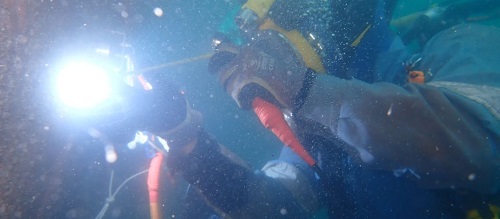
Ans: Yes, 80 per cent of the work. Nevertheless, divers continue to be required in “Tactile” inspections and in undertaking repairs, such as in underwater welding or injecting grout.
Q5. So why is the so-called Splash Zone so corrosive?
Ans: Since the metal is exposed to high levels of oxygen and salt spray at the same time, it creates a “super-cell” of electrochemical corrosion.