If you have been working with your vessels in Singapore for some time now, you already know that the underwater section of the vessel undergoes quite a drastic change rather frequently. Everything works well one month and suddenly, the other month, you realize that your fuel consumption or speed has increased with no apparent reasons.
At this stage, hull cleaning services in Singapore become quite popular among vessel owners and technical crews.
However, in order to choose such services, most boat owners tend to ask a few reasonable questions. Let us take a look at them from a more realistic perspective.
Why does my vessel require so much hull cleaning Singapore-wise?
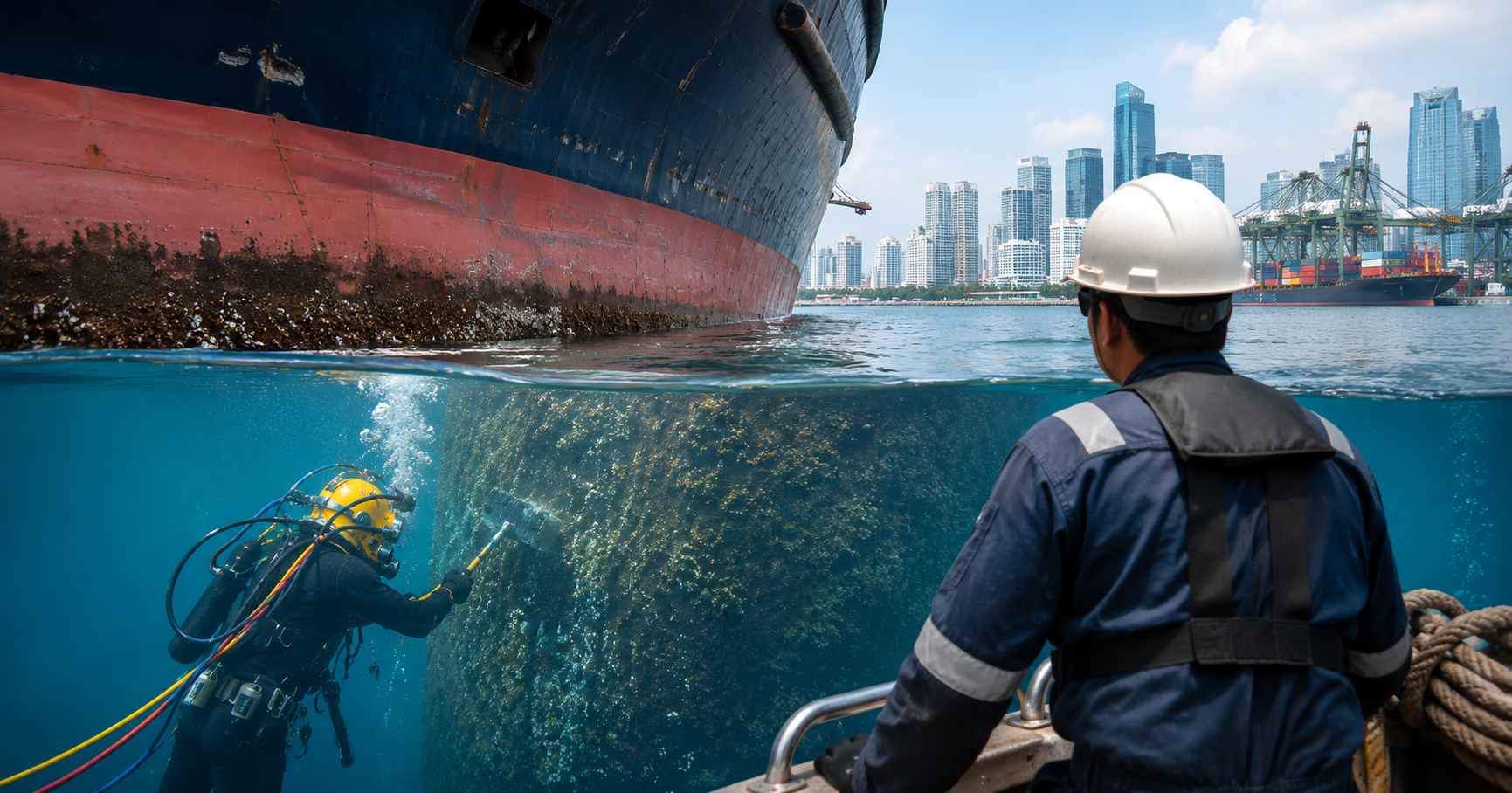
The combination of traffic, warm water, and high marine activity makes Singapore an ideal place for algae and plants to settle on the bottom of the ship.
It will not happen all at once. The fouling process starts with a thin coating, then light fouling, and eventually heavy fouling.
This is why underwater hull cleaning becomes necessary.
Is there a real impact on fuel usage by marine growth?
Yes, but not always immediately obvious.
Once fouling starts to accumulate, the ship is no longer gliding smoothly through water, which increases resistance.
During routine marine growth removal, operators typically observe:
- Decrease in fuel consumption
- Improved speed consistency
- Reduced engine stress during long voyages
- More stable vessel performance
What occurs at a marine maintenance service?
Modern marine maintenance operations in Singapore follow a systematic process. The vessel does not always need to stop operations.
Typical procedures include:
Hull cleaning
Removal of slime, algae, and barnacle layers using divers or specialized cleaning equipment.
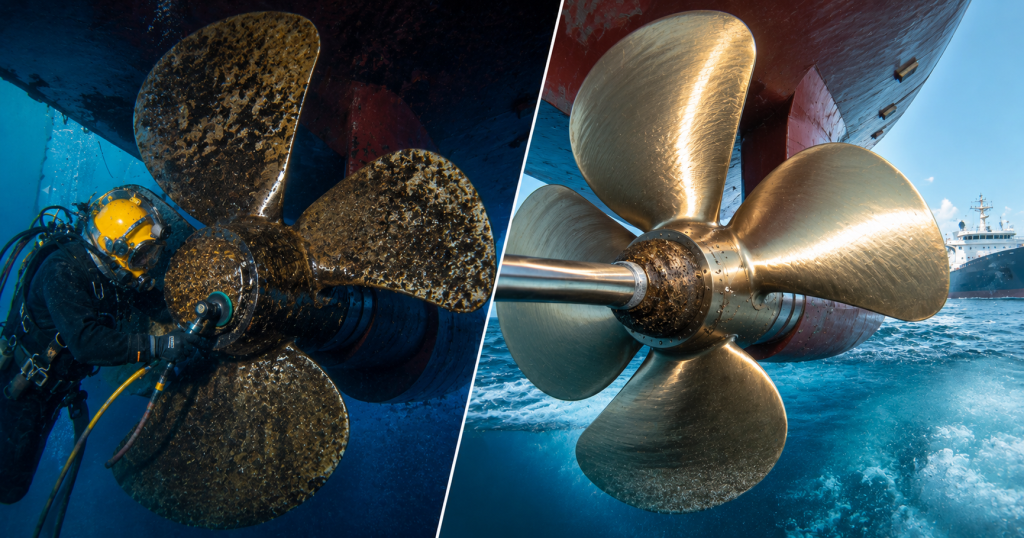
Propeller polishing
Smoothing and restoring propeller blade surfaces for better hydrodynamic efficiency.
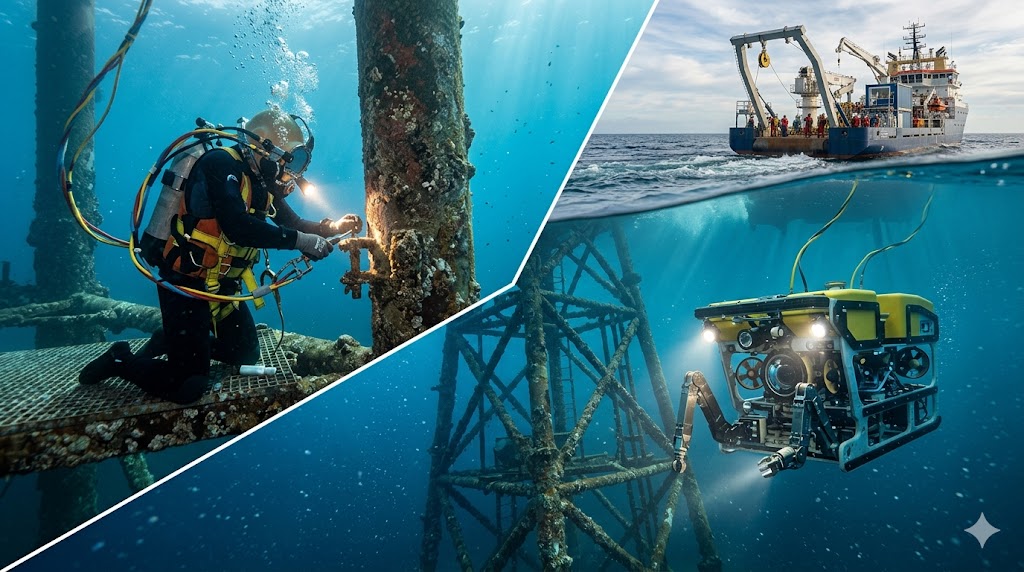
Underwater inspection
Detailed evaluation of hull condition, coatings, and underwater fittings.
Sea chest cleaning
Removal of blockages that may affect cooling system performance.
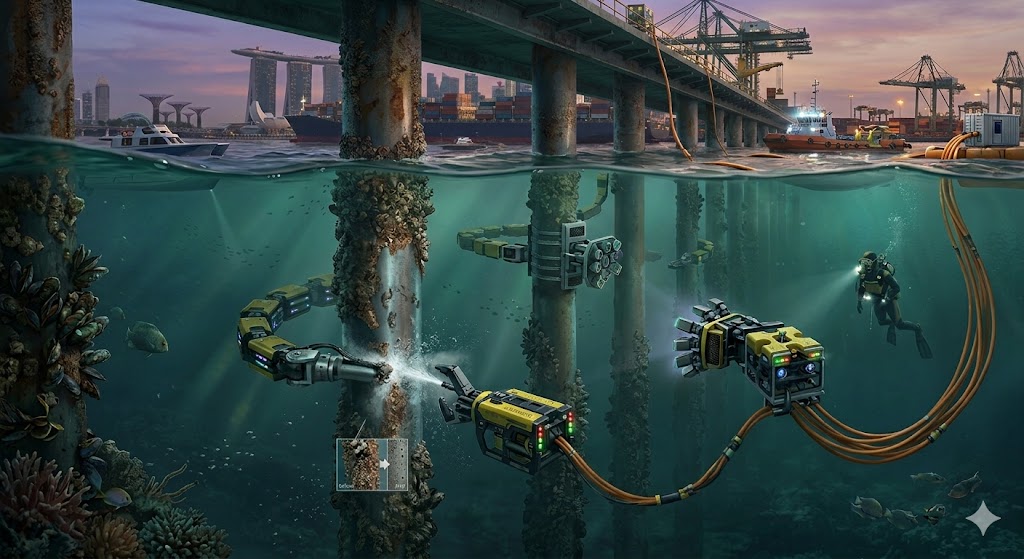
Robotic underwater cleaning
Use of automated systems for controlled and consistent cleaning.
Is underwater cleaning dangerous for the ship?
This is one of the most common concerns and a valid one.
The short answer: it can be safe when performed by trained professionals.
Each vessel has a specific coating system, so cleaning methods are adjusted accordingly to avoid damaging protective layers.
Today, robotic underwater cleaning is often preferred due to its consistency and controlled pressure application.
What cleaning frequency is required?
There is no fixed rule, but in Singapore, vessels are commonly cleaned every 4–6 months.
However, frequency depends on:
- Vessel usage intensity
- Time spent at anchorage
- Type of vessel and operational routes
- Environmental conditions
Most operators prefer regular inspection rather than waiting for performance decline.
Can propeller polishing improve vessel performance?
Yes, often significantly.
A fouled or damaged propeller disrupts water flow and reduces efficiency.
After polishing, operators often notice:
- Improved vessel responsiveness
- Reduced vibration
- Smoother movement
- Gradual fuel efficiency improvement
It is a relatively low-cost maintenance activity with noticeable operational benefits.
What kind of problems do ship owners have before arranging services?
Common concerns include:
- Will vessel operations be interrupted?
- How long will the process take?
- Is it safe for crew and equipment?
- Can inspection and cleaning be done together?
- Are compliance requirements met?
Offshore vessel cleaning services are typically planned to ensure continuous operations without downtime.
Why is Singapore a good place for offshore services?
Singapore is one of the world’s major maritime hubs, offering highly reliable marine services.
Key advantages include:
- Experienced diving professionals
- Advanced inspection technology
- Strong safety and compliance standards
- Fast response and execution times
- Large volume of vessel traffic supporting service availability
FAQs
What is hull fouling in simple terms?
It is the buildup of marine organisms like algae and barnacles on the ship’s hull.
Does hull cleaning increase fuel efficiency?
Yes. Removing fouling reduces resistance and improves fuel efficiency.
Is underwater inspection compulsory?
No, but it is strongly recommended as preventive maintenance.
What does robotic underwater cleaning do?
It provides controlled cleaning with consistent pressure, reducing the risk of coating damage.
Does it help with environmental regulations?
Yes. Improved efficiency reduces fuel consumption and supports IMO compliance goals.
Conclusion
For ship operators in Singapore, underwater maintenance is not just an emergency action—it is part of regular operational efficiency.
Hull cleaning, propeller polishing, and underwater inspections all work together to ensure optimal vessel performance and reduced operating costs.
A clean hull consistently delivers one key advantage: smoother, more efficient maritime operations.