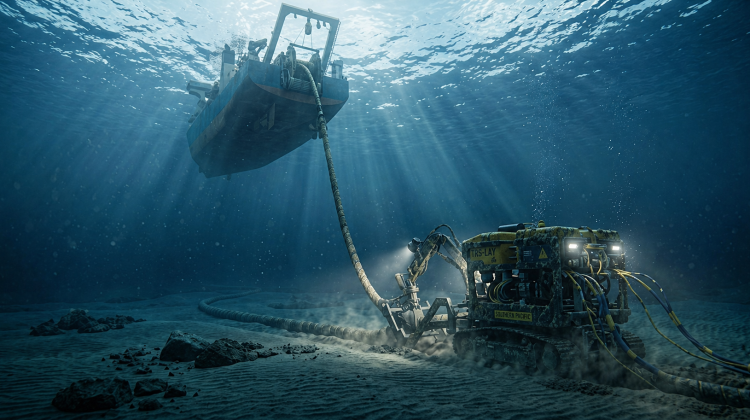
Underwater Cable Laying: Complete Offshore Guide
The contemporary world is connected with the gigantic invisible net of underwater arteries. Be it the fast exchange of data that drives the world wide internet, the large electrical power flowing from offshore wind farms to the mainland, or underwater cable laying, it is the foundation of world connectivity.
Nevertheless, the deep-sea environment is among the most hostile places on earth. There are always threats of high pressure on the subsea assets, corrosive salt water, movement of tectonic plates, and human activities such as commercial fishing. Correct installation is not an amateur operation that involves placing a line in the water; it is an offshore engineering art of high accuracy that should be accompanied by high-technology and specialized ships and be thoroughly planned to guarantee high performance and durability in the long run.
What is Underwater Cable Laying?
Underwater cable laying is the art of laying power cables or fiber-optic communication cables on the seafloor or under the seafloor. Also known as submarine cable laying, this field requires complicated logistics and underwater engineering to connect islands, continents, and offshore energy platforms.
Engineers can use subsea cable laying services to connect remote offshore wind turbines to the electrical grid or to connect data centers in oceans. It aims to establish a safe and stable route to energy and information that can endure decades with a minimum of interference.
Types of Underwater Cables
Cables are not all created equally. The mode of installation is greatly dependent on the physical traits and purpose of the cable:
- Power Transmission Subsea Cables: These are thick, armored, heavy, and are commonly used. They are used to transport high-voltage electricity and are critical to the oil and gas subsea cable installation industry and renewable energy projects. They need to be able to withstand a lot of heat and electrical pressure.
- Telecom Submarine Cable Installation: They are unbelievably skinny (not much bigger than a garden hose), but are coated with several layers of steel wire and polyethylene to shield the fragile glass fibers that hold the data of the world.
Underwater Cable Laying Process
The cable laying process offshore is a multi-stage operation where every detail is calculated months in advance.
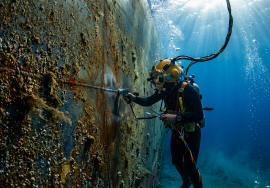
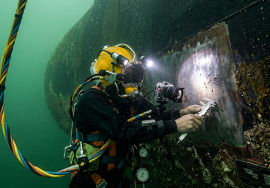
- Route Survey and Seabed Analysis: Even before a vessel has exited the port, a cable laying a seabed survey is carried out. Engineers map a route by using side-scan sonar and sub-bottom profilers, ensuring that they do not hit underwater volcanoes, shipwrecks, and deep-sea trenches.
- Cable Transportation: Hundreds of kilometers of cable are loaded into special cable-laying vessels and are stored in huge circular tanks (carousels) to avoid kinking.
- Laying and Positioning: The vessel uses Dynamic Positioning (DP) technology to move centimeter-accurately, unspooling the cable at a specific tension to keep it on the followed path.
- Burial or Protection: The cable is buried under the seabed with special equipment to avoid being damaged by anchors or trawlers.
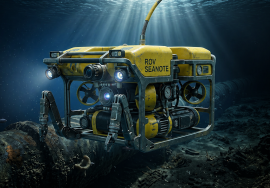
- Inspection and Testing: ROV cable installation crew operates robotic cameras to check the position of the cable and conducts an electrical checkup to check the integrity of the signal or power.
Technologies Used in Cable Laying
The installation is based on a complex of new-technology marine devices:
- Dynamic Positioning Vessels: Vessels that hold a fixed position, with computers and thrusters, no matter what the wind or the current does.
- Cable Ploughing and Jetting Systems: A “plough” is drawn behind the ship to plough and bury the cable in a single pass. In softer sediments, high-pressure water is used to liquefy the sand in order to allow the cable to sink to a safe depth using jetting ROVs.
- Subsea Operations ROVs: Remotely Operated Vehicles are the eyes of the project, which check the tip of the cable on the bottom of the ocean.
Cable Protection and Burial Methods
Cable trenching subsea is a major defense measure in high-traffic zones or rocky terrain.
- Trenching: Placing the cable 1 to 3 meters under the seabed.
- Rock Placement: When the bottom of the sea is too rocky to trench, special ships drop tons of rock onto the cable to form a protective layer of armor.
- Articulated Pipes: Piping the cable with heavy cast-iron shells in places where the cable comes out of the water at the shore.
- Keywords: cable protection systems, marine installation challenges.
Applications of Underwater Cable Laying
Subsea engineering services are in demand in a number of key areas:
- Offshore Wind Farms: Linking huge arrays of turbines to a central substation. The most rapidly expanding area of subsea construction is currently offshore wind farm cable laying.
- Oil and Gas Platforms: Remote offshore rigs are run onshore to ensure that there is a reduction on carbon emission in offshore rigs.
- Telecommunications: Supporting the fiber-optic backbone of the internet.
- Intercontinental Interconnectors: Countries should be allowed to sell excess renewable energy internationally (e.g., solar energy in North Africa to Europe).
Benefits of Professional Cable Laying Services
Contracting a skilled marine installation firm offers a significant payback:
- Less Maintenance Risk: A well buried cable is 10 times less likely to be destroyed by external influences.
- Environmental Compliance: The professionals make sure that the installation does not have a lot of influence on marine life, as well as coral reefs.
- Effective Project Implementation: Advanced DP ships are capable of operating in harsher weather, and this saves costly delays in the project.
How to Choose the Right Cable Laying Contractor
A cable laying contractor is an ally in the long-term success of your project. Assess them according to:
- Vessel Capability: Do they own, or have access to, DP2 or DP3 class vessels?
- Depth of Surveys: Are they capable of the particular depths needed by your project (deep-water or shallow-water)?
- Safety History: Subsea work is hazardous; seek businesses that have a zero-incident culture and international certifications.
Select professionals in trustworthy underwater cable laying services.
Cost of Underwater Cable Laying
The cost of laying underwater cables is very fluctuating. The budget of a project is calculated by:
- Distance: This is the distance of the cable run.
- Seabed Complexity: Hard rock is costly to trench or place rock, whereas sand is cheaper.
- Depth: More complex ROVs and larger vessels are needed on deep-water installations.
Expert Tip: It can save millions of dollars to invest in a better seabed survey at the beginning of the project that will prevent millions of dollars in lost time caused by an unexpected ground condition, which could bring an installation to a halt.
Future Trends in Subsea Cable Installation
The industry is expected to develop with the help of advanced offshore technology:
- Small Autonomous Cable Layers: Small autonomous cable repair ships.
- AI Route Optimization: Machine learning to optimize the route through years of tidal and geological data to determine the ideal route.
- Smart Cables: A cable is installed to include sensors that can sense a break or a seismic event, and the precise position is reported immediately.
Conclusion: Powering Connectivity Beneath the Sea
Underwater cable laying is the final union of mechanical power and computer-like accuracy. With the trend towards an increasingly electrified and connected world, the capability to install such subsea assets safely and efficiently is now more important than ever. With the most advanced ROV systems and careful seabed mapping, professional installation crews are making sure that our energy and data superhighways are safe under the water over the next generations.
Get in touch with us to have expert solutions for laying underwater cables.
Frequently Asked Questions (FAQ)
Q1. What is the maximum depth of underwater cables?
Ans: The current ships are able to lay fiber optic cables in a depth of up to 8,000 meters (the maximum depth of ocean trenches). The heavier power cables have a restricted depth of about 3,000 meters.
Q2. What will occur when an underwater is broken?
Ans: A special cable repair ship is sent. They locate the two ends of the broken cable with an ROV or a grapnel, and then retrieve them to the surface and “splice” them back together in a sterile onboard environment before relaying them.
Q3. Do sharks attack underwater cables?
Ans: Although this was a problem in the early fiber optic days (since the electromagnetic fields were enticing the sharks), the new cables have shielding and armoring, which makes them virtually bite-proof.
Q4.What is the life span of submarine cables?
Ans: The service life of most subsea cables is 25 to 30 years, although many have been in service much longer with appropriate protection.
Q5. Do underwater cables pose a threat to the environment?
Ans: No. A majority of cables are made of neutral materials. The major environmental issue is the installation procedure, which is why professional contractors apply methods to reduce the disturbance of sediments.