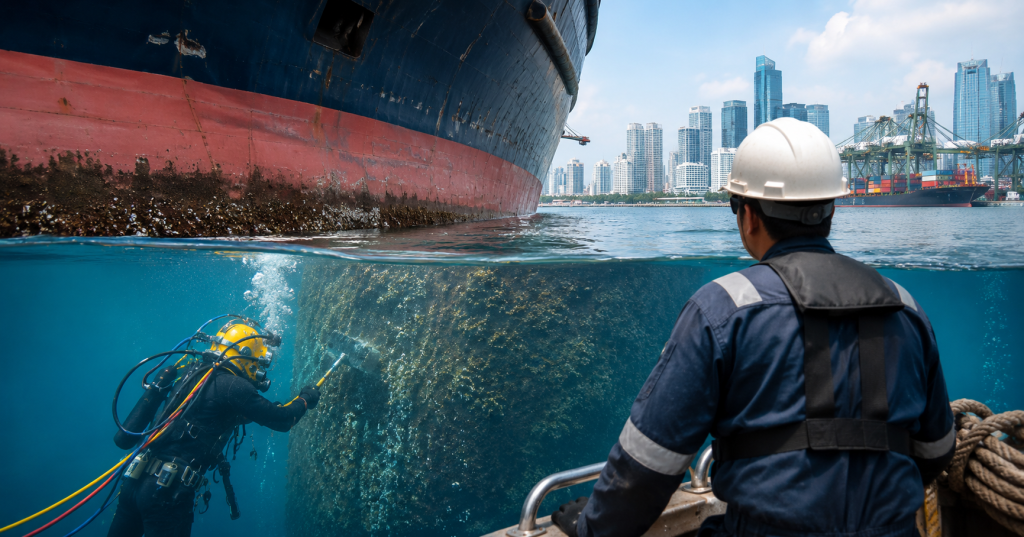
The sea transport is experiencing a digital revolution where safety and efficiency cannot be compromised. Over the decades, commercial divers were the main way of evaluating the underwater health of a vessel, a process that was both physically dangerous, had low visibility, and was poorly reported. Robotic hull inspection has emerged as the intelligent alternative to human intuition nowadays, with the precision of sensors and autonomous mobility.
With the increase in environmental regulations and the cost of doing business, a fast, accurate hull audit of a vessel is a competitive edge. The level of detail that can be offered by robot systems cannot be matched by traditional methods, so that corrosion, biofouling, and structural defects are detected before causing expensive repairs or environmental accidents.
What is Robotic Hull Inspection?
Robotic hull inspection is the inspection of submerged and splash-zone parts of a vessel, using specialised, remotely controlled or autonomous machines to scan and analyse the area. These robotic hull inspection services are better than traditional services since the technology can withstand such extreme pressures, low visibility, and hazardous conditions without exposing human lives to danger.
With the implementation of automated hull inspection units, shipowners can receive a full-fledged digital twin of the state of their hull. This data-based method enables specific maintenance planning and a validable document to the class societies and insurance companies.
Technologies Used in Robotic Hull Inspection
A highly advanced payload on the machine is what makes a robotic survey effective. Advanced marine technology of modern times has incorporated a number of basic systems:
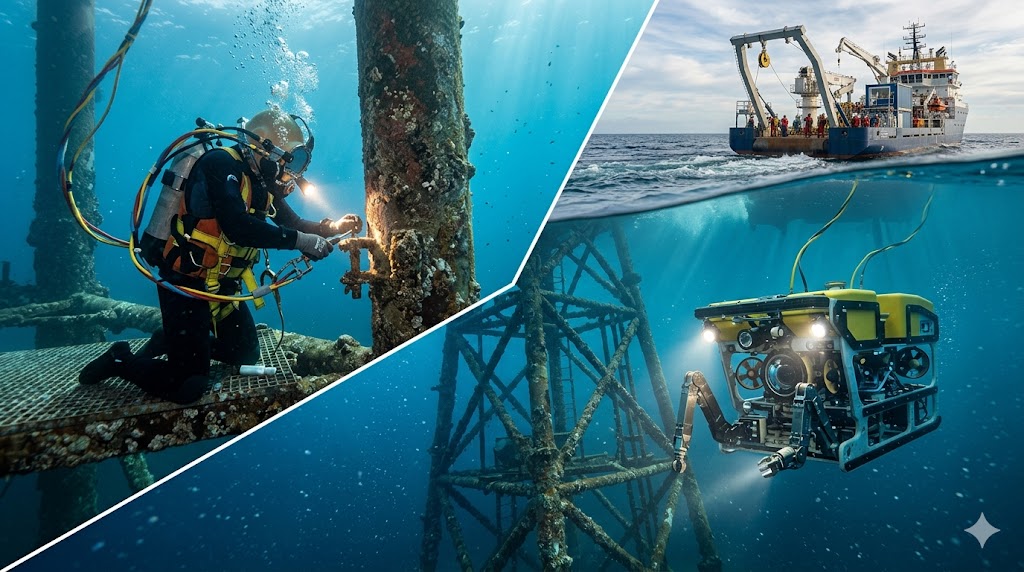
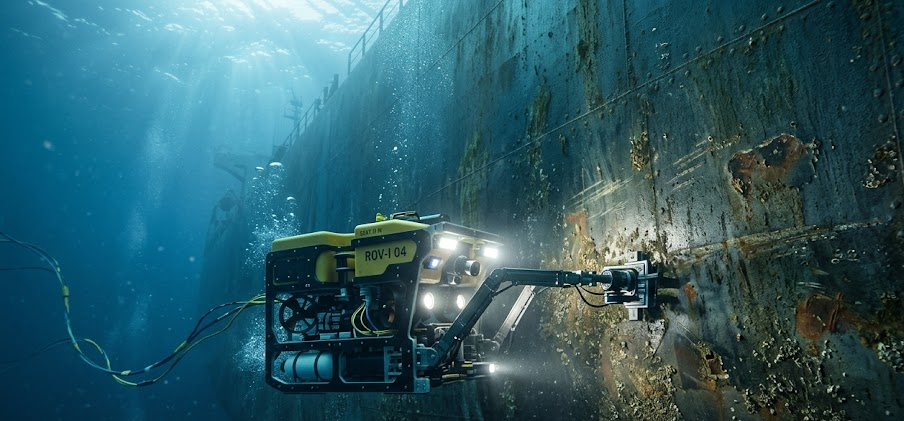
- ROV-Based Inspection Systems: Multipurpose Remotely Operated Vehicles that can move about 3D space to check propellers, rudders, and sea chests.
- Magnetic Crawler Robots: These are special robots that adhere to the steel hull with strong magnets and move in a grid pattern to ensure a complete surface coverage.
- AI-Based Hull Inspection: Machine learning algorithms to monitor video feeds in real-time to automatically identify anomalies, e.g., “pitting” corrosion or certain forms of invasive species.
- Ultrasonic Thickness (UT) Measurement: Built-in NDT instruments that gauge the remaining steel plate thickness beneath the hull coating.
How Robotic Hull Inspection Works
The process is developed to have minimal disturbance to vessel operations.
- Deployment: The robot is either launched on a small support vessel or on the deck when the ship is at anchor or even when loading or unloading cargo.
- Navigation: The robot uses advanced technology to determine its precise position on the hull, either by acoustic positioning or SLAM (Simultaneous Localization and Mapping) technology.
- Data Acquisition: 4K cameras and sonar sensors are used to capture the surface condition.
- Reporting: This information is summarized into a cloud report, which will give the operator a heat map of hull integrity.
Applications of Robotic Hull Inspection
High-value maritime industries are quickly adopting these services:
- Cargo Vessels: Reduction of fuel use through maintenance of smooth, non-drag-inducing biofouling of the hull.
- Oil & Gas Offshore Vessels: Conducting offshore vessel inspections on FPSOs and platforms where safety zones tend to limit diving.
- Tankers: Tanker hull inspection in volatile conditions should be done by persons where the use of spark-proof robots would be safer.
- Port and Harbor Operations: Rapidly auditing quay walls, pilings, and submerged infrastructure.
Benefits of Robotic Hull Inspection
There are three major areas through which the Return on Investment (ROI) of switching to robotics is available:
- Safety: With the elimination of the human in the water, companies are able to eliminate the major dangers of commercial diving, including the differential pressure (Delta-P) and entanglement.
- Precision: Robots are not fatigued or chilled. They offer a consistent, high-quality feed and repeatable data that are year-by-year comparable.
- Turnaround Time: A robotic crawler may frequently scan a hull quicker than a group of divers, decreasing the amount of downtime in the port of a vessel.
- Keywords: asset integrity management, marine asset inspection.
Robotic Inspection vs. Diver Inspection
| Feature | Traditional Diver | Robotic Systems (ROV/Crawler) |
| Risk Level | High (Human Life) | Low (Asset Only) |
| Data Consistency | Subjective (Diver) | Objective (Digital Sensors) |
| Operational Window | Restricted by current/light | Long (24/7 availability) |
| Surface Coverage | Spot checks | 100% Hull Mapping. |
| Environmental Impact | Minimal | Zero (Reclaim systems available) |
Role of NDT in Robotic Hull Inspection
Non-destructive testing (NDT) is the vehicle that is delivered by robotics. A robotic survey is not merely a look at the hull but a diagnosis of the hull by combining NDT tools.
- Corrosion Detection: Before galvanic cells and coating failure develop into structural failure, identifying them and preventing their development.
- Weld Integrity: Eddy Current or Close-Up Visual (CVI) is used to examine the health of longitudinal and circumferential hull welds.
- Cathodic Protection (CP) Monitoring: This is a method of measuring voltage levels of anodes in the hull to verify that the structure is still electrically guarded.
How to Choose the Right Service Provider
The following technical standards should be sought in a hull inspection company:
- Sensor Payload: Are they video only? (e.g., Sonar, UT, and CP probes).
- Stability in Current: Do their ROVs have a stable station in high-flow port environments?
- Data Portals: Do you have an online dashboard where you can monitor the degradation of hulls over time?
Select professionals to offer effective robotic hull inspections.
Cost of Robotic Hull Inspection
The day rate of high-end robotics may be more than a simple dive team, but the cost of robotic hull inspection is counterbalanced by speed.
Expert Hint: The actual saving lies in Fuel Efficiency. An underwater survey can be used to identify slime at its tender stages, which a diver may be unable to see. Robotically-based data cleaning that slime can save 5-12% of fuel per year.
Future of Robotic Hull Inspection
We are going towards Hull Inspection 4.0:
- Full Autonomy: Systems that are in “docks” on the seabed and clean/inspect a vessel automatically each time it comes into port.
- Predictive Analytics: With the information obtained, it will be possible to predict precisely when a hull will require a complete overhaul of the paint, and millions of dollars will be saved in the dry-docking process.
- Reclaim Systems: Cleaning and inspecting robots that can vacuum up marine growth in order to save local ecosystems.
Conclusion: Smarter Marine Inspections with Robotics
Robotic hull inspection has ceased to be a futuristic idea; it is an actual operational need. Focusing on safety, data accuracy, and speed, robotic systems enable the maritime operators to control their assets with unprecedented precision. In a business where time is money and safety is the key, automation is the sole direction to take.
Send us a request today to have the advanced robotic hull inspection services.
Frequently Asked Questions (FAQ)
Q1. Is it possible to have the ship in motion and have a robot do an inspection?
Ans: Existing technology enables inspections at extremely low speeds (below 1-2 knots) or whilst at anchor. In-transit robots are still in experimental stages of full-speed inspection.
Q2.Is a robotic inspection compliant with Class?
Ans: Yes. In the majority of major classification societies (including ABS, DNV, and LR), the high-quality robotic video and NDT data is now accepted as a valid In-Water Survey (IWS) in place of dry-docking.
Q3. What occurs in water with no visibility?
Ans: Robots have a vision to see through mud and silt, using Multibeam Sonar. This enables the robot to form a 3D picture of the hull despite the fact that the water is pitch black.
Q4. Will robots be able to substitute the divers completely?
Ans: For inspection, yes. Human divers are still usually needed to support the robotic tools when it comes to complex physical repairs, such as underwater welding or the replacement of propellers.
Q5. What is the length of time to take a complete hull scan?
Ans: A detailed robotic scan can be done in 8-24 hours, depending on the size of the vessel and the number of crawlers deployed.