The oceans are considered to be the most aggressive to man-made structures. A continuous process of degradation starts as soon as a steel jacket is submerged or a subsea pipeline is laid. Structural failure, in this high-stakes arena, is not merely a costly logistical challenge; it is a possible environmental, human disaster.
Underwater NDT and corrosion control are the detection and protection methods that characterize contemporary offshore engineering. With a pressure to find a way of using Non-Destructive Testing (NDT) to detect concealed cracks, and with such a mechanism in place, in conjunction with a complex electrochemical barrier against rust before it begins, operators can make their assets last decades beyond what they were originally intended to last.
What is Underwater NDT?
Non-Destructive Testing (NDT) is a science of testing a material or component without changing its physical condition or integrity. Underwater NDT inspection in the underwater industry is the most common method of seeing through the dark depths and the blankets of marine life to inspect the steel beneath.
Subsea NDT services cannot be conducted by surface testing, but rather use special equipment that can withstand the extreme hydrostatic pressure and provide high-fidelity data in the saltwater environment. Only in this way is it possible to ensure that the inside health of a structure is in line with its exterior look.
Understanding Corrosion in Marine Environments
Oceanic corrosion is not simply rust, but a complicated electrochemical process. Seawater is an electrolyte that helps in the movement of ions between various points on a metal surface.
Marine corrosion control is a challenge that is accelerated by several factors:
- Salinity: When the content of the salt in the water is high, the conductivity of the water is elevated, accelerating the loss of electrons.
- Oxygen Levels: More oxygen in the splash zone makes it the most corrosive on any platform.
- Temperature: Chemical reactions in warmer tropical waters (such as Singapore or the Gulf) are much faster.
- Microbial Influence: Some bacteria consume the protective film on steel, resulting in localized pitting.
- Keywords: electrochemical degradation, offshore corrosion protection.
Common Underwater NDT Methods
A range of underwater NDT inspection methods is used to identify defects prior to their turning into structural violations:
1. Ultrasonic Testing (UT)
The most frequent technique for measuring the loss of the wall. Ultrasonic testing underwater may be used to ascertain the precise remaining thickness of a pipe or hull, even with only one side of it available, by passing high-frequency sound waves through the metal.
2. Magnetic Particle Testing (MPI).
Applied to locate cracks in the welds that are on the surface. Fatigue is early spotted by underwater specialized fluorescent particles and ultraviolet lights that are used to make the hairline fractures fluorescent to enable divers or ROVs to see the fatigue.
3. Eddy Current Testing
The technique applies electromagnetic induction to locate cracks by using coatings. The fact that eddy current testing for marine work is extremely efficient, since it does not necessarily involve the removal of protective paint or marine growth to be able to obtain a valid reading, is beneficial to marine work.
4. Visual Inspection (CVI & GVI)
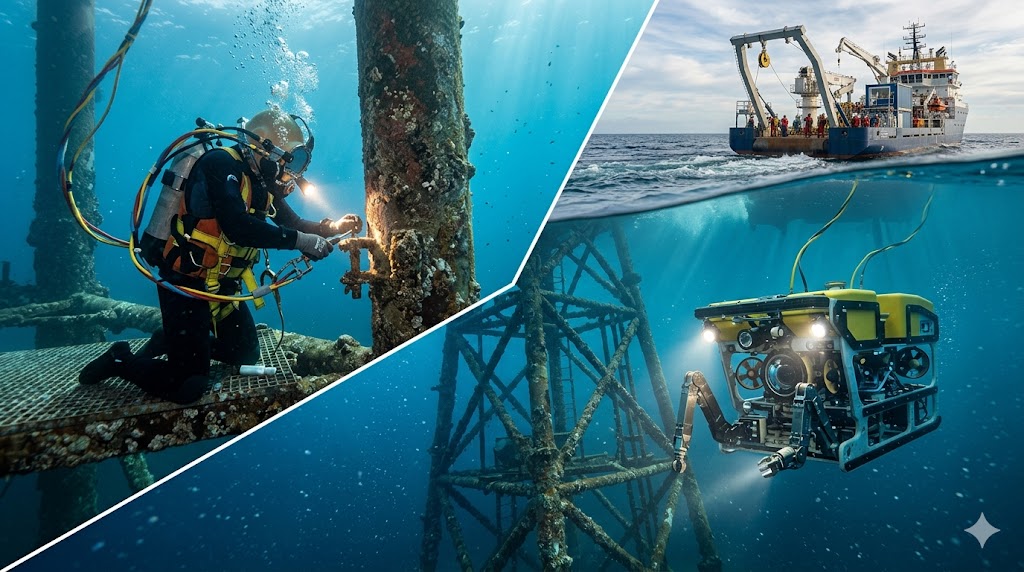
Close Visual Inspection (CVI) and General Visual Inspection (GVI) are still the basics. No matter who is doing it, either a diver or using a ROV NDT inspection, with high-definition cameras, engineers on the surface can examine the inspection of deformation, scouring, or coating failure.
Corrosion Control Methods Used Offshore
After NDT detects a risk, marine corrosion control systems are implemented to counter the threat:
- Cathodic Protection (CP) Systems: The sacrificial anodes (Zinc/Aluminum) or Impressed Current (ICCP), which is a variation of the former, are applied to make the structure the cathode in the electrochemical cell, essentially preventing the rust.
- Protective Coatings and Linings: Sophisticated polyurethane or epoxy coatings that serve to provide a physical barrier. Coating inspection at an offshore location assures that such barriers have no holidays or microscopic holes.
- Corrosion Inhibitors: Chemical treatments that are applied mostly internally in pipelines to create a protective layer on the inside walls of the steel.
- Keywords: underwater cathodic protection, reduction of corrosion.
Applications of Underwater NDT and Corrosion Control
These two fields are the conditions for working in some of the most important fields:
- Offshore Oil & Gas: All the inches of a rig are built on subsea oil and gas inspection between the well and the topside.
- Subsea Pipelines: The maintenance of the integrity of lines that transport high-pressure hydrocarbons over the seabed by pipeline NDT inspection offshore.
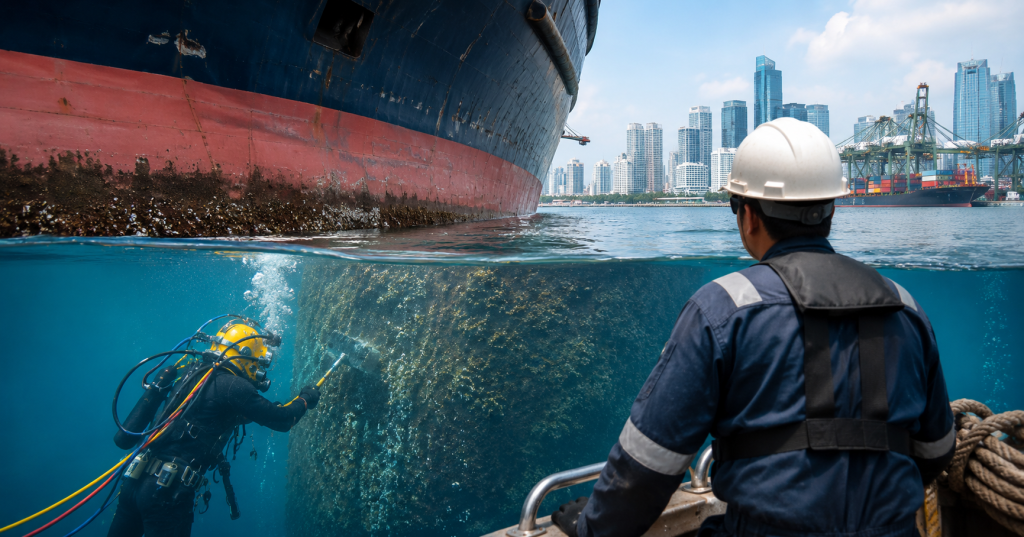
- Ship Hulls: Assistance to vessels to pass In-Water Surveys (IWS) to eliminate the enormous expense of unplanned dry-docking.
- Ports and Infrastructure: Safeguarding the sheet piles and berthing dolphins upon which the world depends for trade.
Importance of Asset Integrity Management
The market has ceased the practice of periodic checks and instead adopted a holistic asset integrity management offshore approach. When NDT data is incorporated into a digital twin, operators are able to view a live health score of their structure. This proactive strategy implies that maintenance is only carried out when necessary, but never before a failure happens, so structural integrity monitoring is an ongoing process.
Benefits of Underwater NDT and Corrosion Control
The payback period is located in the avoided costs:
- Early Detection: A 2mm crack is easy to repair; a 20cm crack is very difficult to repair.
- Long Life of Asset: The planned systems will have a 20-year duration lasting 40+ years because of the improved corrosion management.
- Environmental Protection: The most appropriate solution that can rescue the marine environment and brand image will be avoiding leaks.
- Regulatory Compliance: Compliance with the strict requirements of MOM, IMO, and international classification societies.
Challenges in Underwater Inspection
Our technology notwithstanding, the ocean is a challenge. The problems of subsea inspection include:
- Visibility: There is a possibility of zero visibility due to silt and plankton, and this NDT requires sonar-based.
- Depth: Deep water resources require special underwater inspection contractors who have the ability to work thousands of meters deep with ROVs.
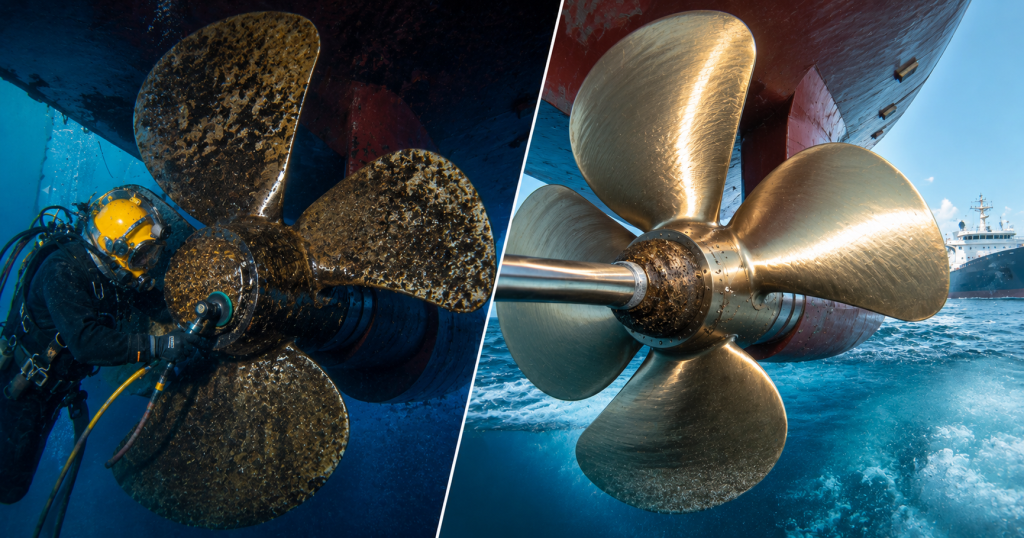
- Cleaning: Marine growth can be inches thick and must be taken off before NDT sensors get in touch with the steel.
How to Choose the Right Service Provider
It is as good as its collector. In selecting an NDT inspection company, check:
- Technician Certification: Are they CSWIP or ASNT Level II/III certified to work underwater?
- Equipment Flexibility: Do they offer a full line of NDT (UT, MPI, Eddy Current) or just video?
- Safety Record: Is the company adhering to IMCA or other subsea safety standards?
Choose a reputable NDT inspection company so that you can have reliable underwater services that are reliable.
Cost of Underwater NDT and Corrosion Control
The underwater NDT cost is a complex variable.
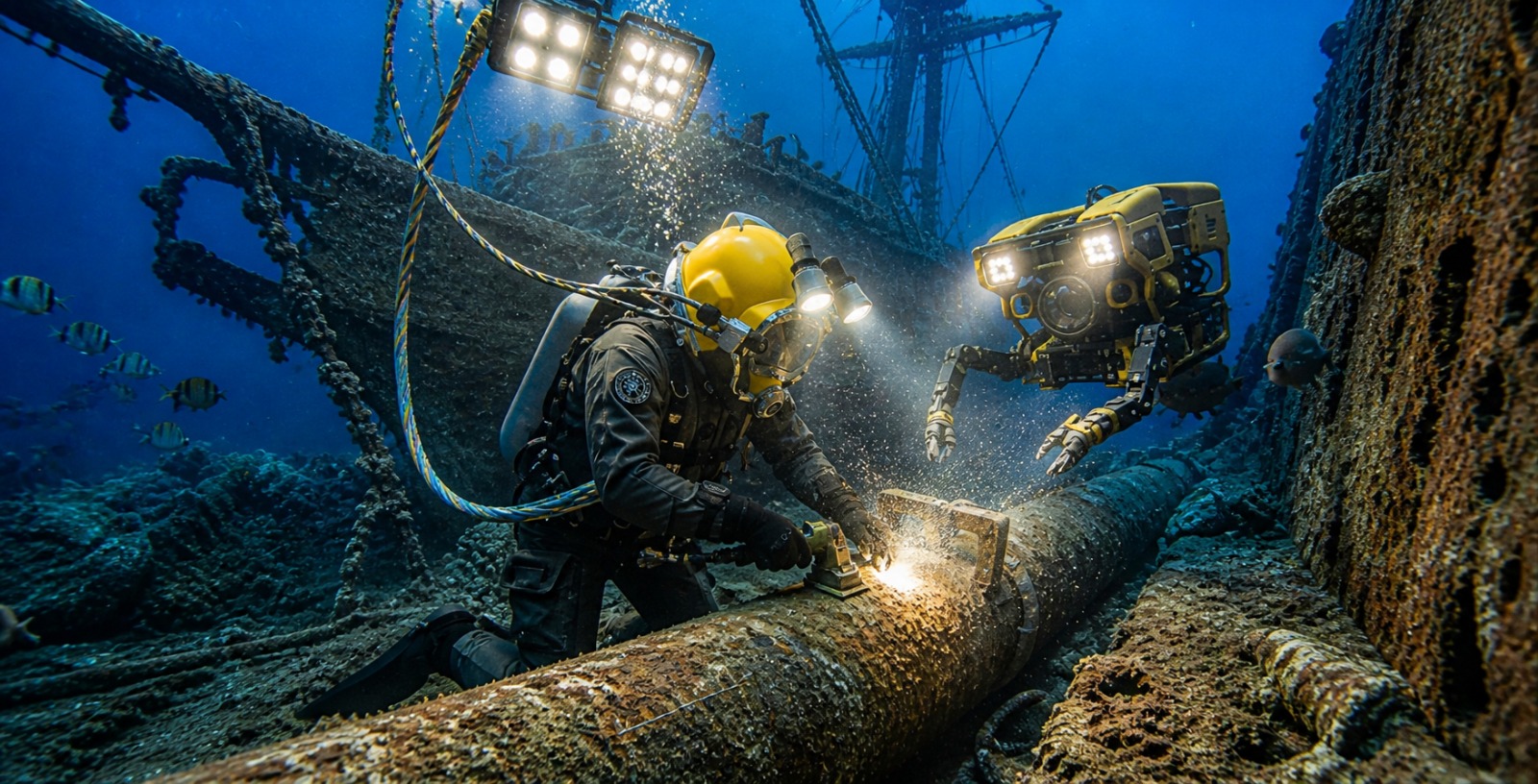
Expert Tip: Although an ROV-based NDT campaign can be more expensive per day than a dive team, the 24/7 work capability of an ROV without decompression breaks can frequently make it more cost-effective when performing a large-scale audit of a pipeline or platform.
Future Trends in Underwater Inspection
Advanced NDT technology is emerging:
- Robotic Crawlers: NDT robots that cling to the side of a ship or a pile, and crawl over it, providing ultra-precise thickness maps.
- AI-Driven Analytics: This software will be capable of automatically detecting corrosion patterns in 1,000 hours of ROV footage.
- Remote Inspection: Onshore specialists operating subsea NDT controlled remotely by a central control room thousands of miles distant.
Conclusion: Protecting Offshore Assets with Smart Inspection
Underwater NDT and corrosion control are not merely technical needs, but an insurance policy for the world marine economy. With the combination of the eyes of NDT and the shield of corrosion control, we could still extract energy and trade safely and sustainably out of the ocean.
Get in touch with us today to get expert underwater NDT and corrosion control solutions.
Frequently Asked Questions (FAQ)
Q1. Is it possible to carry out NDT without cleaning the marine growth?
Ans: Methods such as Eddy Current Testing and some Acoustic Emissions have the capability of working through some layers, but to achieve the high accuracy of ultrasonic testing underwater, the steel is typically polished to a bright finish.
Q2. What is the frequency of checking corrosion control systems?
Ans: The majority of offshore standards suggest that a Potential Survey (testing the voltage of the cathodic protection) be conducted at least once a year.
Q3. What is NDT versus NDE?
Ans: Testing (the act of checking) is NDT, whereas Analysis (deciding what the test results actually mean to the structure) is NDE.
Q4.Is NDT eco-friendly?
Ans: Yes. In contrast to the older techniques, the contemporary NDT involves sound waves, light, or magnets, of which there is no effect on marine organisms.
Q5. Why is the Splash Zone so difficult to cover?
Ans: Due to its constant wet and dry conditions, traditional cathodic protection is not effective there, and coatings are easily destroyed by floating debris or boat hits.