Underwater NDT and corrosion control in Singapore by Master-Tech Diving Services — Ultrasonic Thickness (UT), Magnetic Particle Inspection (MPI), Eddy Current Testing (ECT), Alternating Current Field Measurement (ACFM), plus full cathodic-potential surveys by ASNT/PCN Level II certified diver-inspectors. Class-approved reports for ABS, BV, DNV, Lloyd’s Register, NK, IRS.
What is Underwater NDT & Corrosion Control?
Underwater Non-Destructive Testing (NDT) measures structural integrity of submerged steel without damaging it. Combined with corrosion control assessment (cathodic potential mapping, anode wastage, coating breakdown), it tells you exactly where your vessel or offshore asset is losing thickness — and how much life remains.
For Singapore-based operators, underwater NDT & corrosion control means avoiding unnecessary dry-dockings while satisfying class society inspection requirements. ROI on a single survey is typically 5-10× the cost.
When You Need Underwater NDT & Corrosion Control
- Class survey hull plate measurements — Special Survey, Continuous Hull Survey, IACS Form J
- Suspected hull damage after grounding, contact, or anchor drag
- Annual offshore platform inspection — risers, jacket members, mooring chains
- Cathodic protection audit — verifying ICCP/sacrificial anode performance
- Pre-purchase due diligence — buyer verification of advertised condition
- End-of-life evaluation — extending operating life of ageing assets
Our Underwater NDT Process
- Scope definition — joint with client engineer, class surveyor, and our Level III oversight specialist
- Surface preparation — water-jet cleaning at measurement points (UT/MPI); ECT/ACFM works through coating
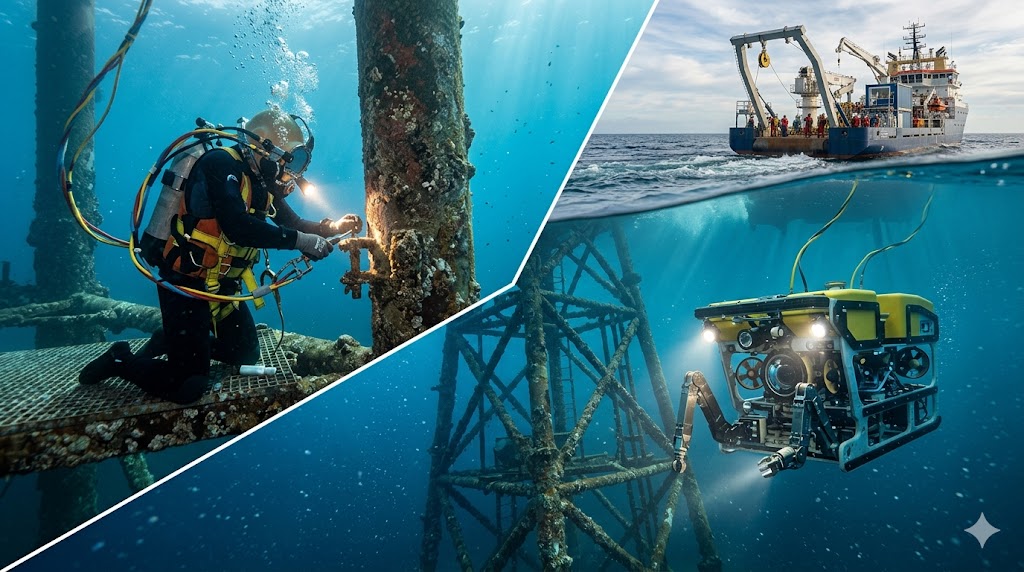
- Inspection execution — diver carries calibrated probe, data streams live to surface inspector for real-time evaluation
- Cathodic potential mapping — Ag/AgCl reference cell readings across hull/structure
- Anode survey — wastage % per anode, photo log, replacement priorities
- Class-format report — measurements vs acceptance criteria, photo evidence, recommended actions
Why Master-Tech for Underwater NDT in Singapore
- ASNT / PCN Level II certified diver-inspectors with Level III oversight
- Class-approved by ABS, BV, DNV, Lloyd’s Register, NK, IRS
- Calibrated equipment — Olympus 38DL Plus (UT), Magnaflux Y7 (MPI), Eddyfi (ECT)
- MPA-registered commercial diving operations, 24/7 mobilisation
- Single-source delivery — survey, repair design, weld/coating execution under one PO
FAQ
UT, MPI, ECT or ACFM — which do I need?
UT for thickness loss; MPI for surface cracks on cleaned steel; ECT for crack detection through paint & marine growth (faster than MPI); ACFM for crack sizing in welds. We recommend the right method during scope definition.
How accurate is underwater UT?
Typical accuracy ±0.1 mm with proper surface preparation. We take 5 readings per point and report the lowest as the conservative residual-thickness value.
Will my class society accept the report?
Yes. We deliver in IACS Form J or your class society’s preferred format with full traceability of equipment calibration and inspector certification.
Get a quote in 2 hours — Call +65 6251 0555 or request via our contact form.