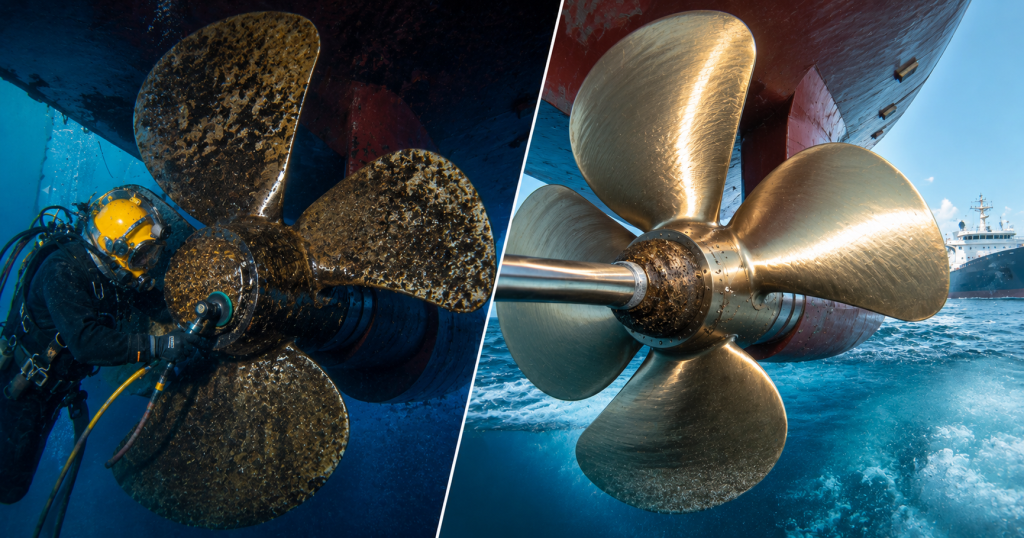
In the competitive environment of maritime operations, a difference between profit and loss may be only a few percentage points in fuel efficiency. The propeller of the ship is the main force behind this efficiency, but it is continuously being attacked by the marine environment. Since the time a vessel has left the dry dock, the biological growth and calcium formations have already started to roughen the surface of the propeller.
Propeller polishing is the technical service of returning the surface of the propeller to a super-smooth surface. This simple process can lead to enormous fuel savings and a major decrease in greenhouse gas emissions, making it a core component of current green shipping projects.
What is Propeller Polishing?
Ship propeller polishing, at its most simple, is the mechanical operation of smoothing out the blades to a certain Grade A or B level, on the so-called Rupert Scale. Whereas marine propeller cleaning is done with the aim of removing large organisms such as barnacles, polishing takes a step higher in which the roughness and calcareous deposits that may be present in the propeller are removed with the use of a microscope.
The touch of a polished propeller is as much like a mirror as a touch can be. This highly polished surface will reduce the development of a turbulent boundary layer and will enable the water to flow over the blades with minimal resistance.
Why Propeller Polishing is Important
The effect of a foul propeller on the hull-propeller-engine system of a ship is immense. The slightest coating of slime or minute roughness is enough to cause a serious loss of propeller performance optimization.
- Fuel Efficiency: A dirty propeller may increase fuel consumption to a point of 5%-10% higher. The quickest method of recovering operational costs is fuel efficiency and ship propeller maintenance in an era of high bunker prices.
- Drag Reduction: Roughness will raise the torque needed to rotate the propeller. By giving attention to drag reduction ship mechanics, you enable the engine to attain the same speed at reduced RPMs.
- Reduced Vibration: Hydrodynamic imbalance in a propeller with an uneven coating results in vibrations that may cause damage to the shaft bearings and seals.
How Propeller Polishing Works
A professional polishing process is a multi-step process that involves accuracy and the use of appropriate equipment.
- Pre-Inspection: Technicians or divers determine the degree of fouling and inspect for indications of cavitation damage or “pitting.”
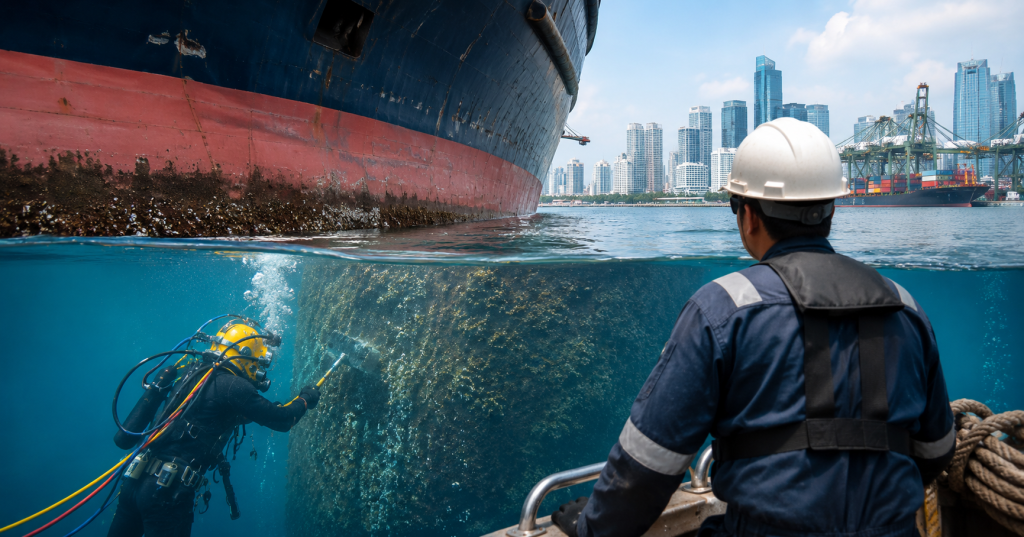
- Biofouling Removal: The marine growth removal propeller is removed using specialized scrapers.
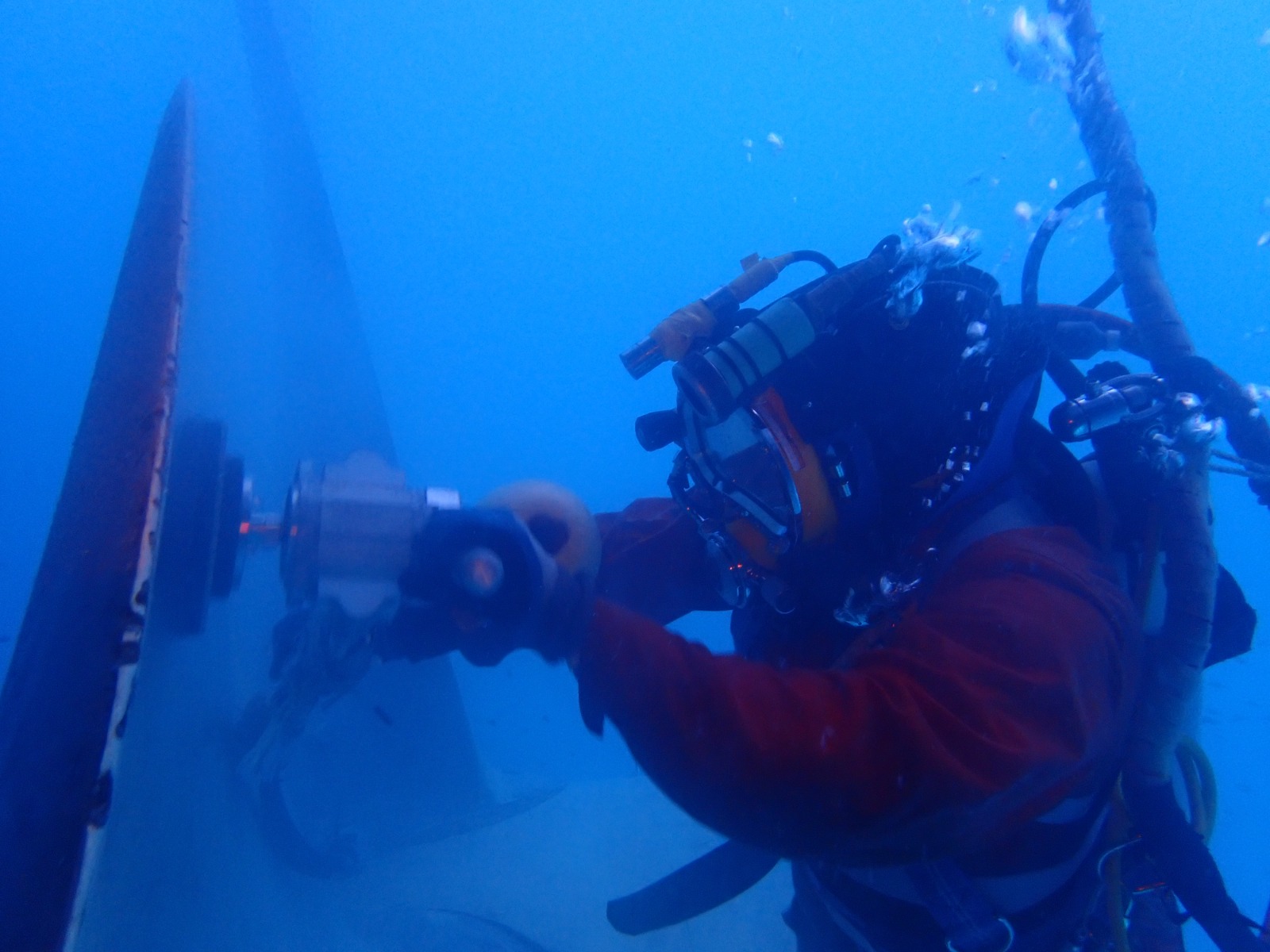
- Abrasive Polishing: With hydraulic tools with rotating abrasive discs (usually 3M or other industrial grades), the surface is ground down.
- Multi-Stage Buffing: This involves the use of coarser to finer abrasive pads in order to produce a mirror finish.
- Post-Inspection & Reporting: High-definition photos are captured to ensure that the propeller is of the desired grade as per the Rupert Scale.
Methods of Propeller Polishing
Three main methods of attaining a polished finish can be achieved, depending on the schedule and location of the vessel:
1. Diver-Assisted Polishing
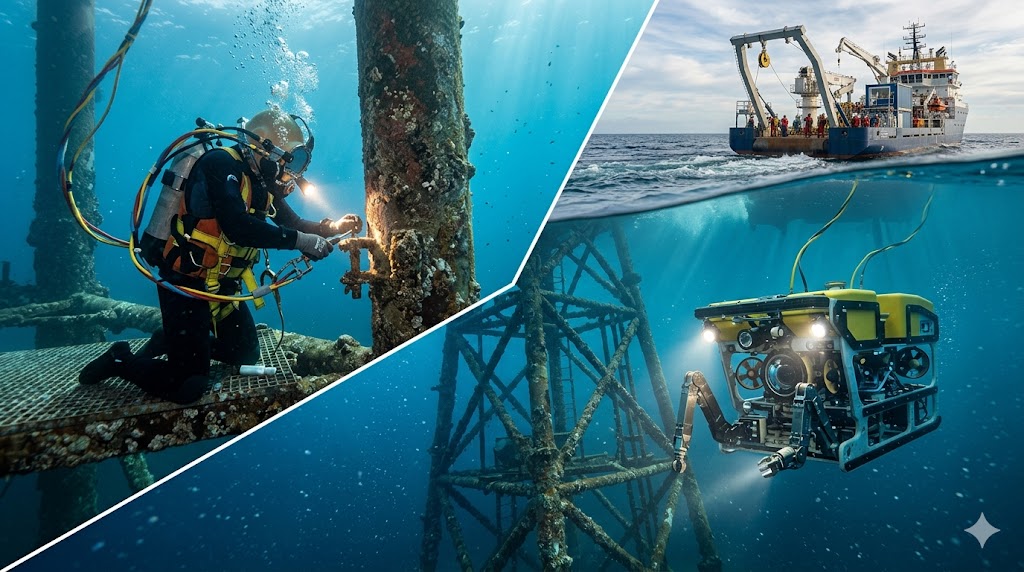
It is the most prevalent type of in-water propeller polishing. Professional commercial divers have handheld hydraulic polishers when the vessel is at anchor or during loading and offloading. A high level of control is possible, particularly around the fragile “leading edge” of the blades through diver propeller polishing.
2. ROV-Based Cleaning
In case of hazardous currents or limited access for divers, ROV propeller cleaning systems are increasingly being used. These remote-controlled vehicles employ specialized brushes and sensors to clean the blades, but are now more effective at cleaning than at high-grade “mirror” polishing.
3. Dry Dock Polishing
This is done during a scheduled survey of the vessel, and thus, the maximum attention is given to the inspection and polishing of the vessel. Since the propeller is not submersible, technicians are able to use bigger tools and undertake more intricate repairs to the blade tips.
Benefits of Propeller Polishing
The payback period of this service is often found in the initial few weeks of sailing:
- Reduced Engine Load: By reducing the resistance to the blades, possible decreases in thermal and mechanical stress in the main engine are achieved.
- Improved Vessel Speed: In the case of vessels with tight schedules, polishing may increase their vessel speed by 0.5 to 1.0 knots at the same power output.
- Energy Efficiency Vessels: Compliance with the Carbon Intensity Indicator (CII) and EEXI regulations is significantly easier to comply with when the propulsion system is optimized.
- Prolonged Component Life: Your reduction of vibration and cavitation will protect the entire propulsion train.
Impact on Fuel Efficiency and Performance
The physics are also straightforward: the results of fuel efficiency of the ship propeller are dependent on the thickness of the boundary layer. When the propeller is coarse, the water will stick to it and leave the energy wasted in a wake. An elegant propeller cuts the water.
It has been shown that polishing a propeller twice a year may be more economical than a major polish that is done once a year, because it keeps the vessel constantly moving at the optimum hydrodynamic curve.
When Should Propellers Be Polished?
In maritime maintenance, timing is everything. When you should consider a polish is:
- Fuel consumption surges: When your fuel monitoring system says your fuel consumption has suddenly increased by 3%, and there is no change in the weather.
- Vessel has been idle: Biofouling is assured in case a ship has been idle in tropical waters for more than 1014 days.
- Every 6 months: Polishing is now becoming a common biannual activity of many leading ship managers to ensure that energy efficiency vessels remain within their performance limits.
Challenges in Underwater Propeller Polishing
High standards underwater can be achieved by overcoming a number of underwater maintenance challenges:
- Visibility: Divers have to work by feel, in silty river ports, and therefore, reaching Rupert Grade A is challenging.
- Weather Conditions: Strong currents or heavy swells may make it risky for the divers to work at the stern of the ship.
- Environmental Regulations: It is now mandatory that some ports have so-called capture systems to ensure that the removed biological material does not enter the local ecosystem.
Choosing the Right Propeller Polishing Service
Not all “cleanings” are “polishes.” When selecting an underwater cleaning contractor or marine maintenance company, ensure they provide:
- Before/After Photos: Detailed photos of the quality of the surface.
- Rupert Scale Verification: Documentation stating the final grade achieved.
- Hydraulic Equipment: Air-powered tools cannot always be used to polish to the same high grade as hydraulic systems.
Select a reputable marine service firm to get quality propeller polishing service.
Cost of Propeller Polishing Services
Propeller polishing cost is a fraction of the fuel it conserves. A professional polish of a medium-sized container ship or tanker is a small cost of operation in comparison to the enormous savings in fuel burn realized during long-haul journeys. The service is self-paying right away as a result of the enhanced efficiency of the engine and the reduction of the bunker consumption.
Expert Tip: Do not pay much attention to the first invoice, but to the Specific Fuel Oil Consumption (SFOC) data collected following the polish. The only means by which you can gauge your real ROI and the sustainability of your propulsion system in the long-term is through this real-time performance tracking.
Future Trends in Propeller Maintenance
- Nano-Coatings: Advanced Coatings that make the propeller smooth longer, decreasing the amount of time it takes to polish the propeller.
- Automated Hull & Propeller Crawlers: Small robots that remain on the vessel and perform micro-polishing every time the ship is in port.
- Advanced Marine Maintenance Technology: Laser-scanning of a propeller to produce a 3D digital twin of the propeller to monitor wear and “pitting” throughout the operating life of the propeller.
Conclusion: Boost Vessel Efficiency with Proper Polishing
One of the most effective yet low-cost interventions shipowners can implement today is propeller polishing. You save the carbon footprint, save the engine, and save a significant amount of fuel by restoring the hydrodynamic profile of the blades. In a maritime business that is becoming more and more characterized by efficiency and environmental stewardship, a smooth propeller is no longer a choice, but a necessity.
Call us today and have your professional propeller polishing.
Frequently Asked Questions (FAQ)
Q1.Is it better to polish or to clean?
Ans: Yes. Cleaning takes away the “big” proliferation, such as the barnacles. The microscopic roughness that imposes drag can only be removed through polishing, even when the propeller may appear clean to the naked eye.
Q2.Is it possible to repair the damage caused by cavitation with polishing?
Ans: Minor cavitation-induced “pitting” can be removed by polishing, which helps prevent the spread of the damage, although severe structural damage may require welding or “grinding” to repair.
Q3. Will the metal be damaged during the propeller polishing?
Ans: No. Professional polishing does not remove anything other than the foul and a film of metal oxidation (microns), which actually protects the integrity of the alloy.
Q4. How many minutes does the average polish last?
Ans: In the case of a 5-bladed propeller, on one of the large merchant vessels, a professional dive team can finish a high-quality polish in 4 to 6 hours.
Q5. What is the ‘Rupert Scale’?
Ans: It is the international standard that quantifies the roughness of propeller surfaces with Grade A (mirrored) on one end and Grade F (very rough) on the other end.